
Get Started: Schedule a session today!
Tamara Malinoff - Psychoeducator
  • Home
  • About
  • Services
    • Early Childhood
    • Middle Childhood
    • Individual Support
  • Resources
    • Blog
  • Contact
  • en EN
    • en EN
    • fr FR
  • Menu Menu

As the school year comes to an end, many are looking forward to their favorite familiar places like summer camps (day or sleepaway), and family vacations. While it is an exciting time, it is also a time of transition. Transitions can be challenging for both children and parents.

Some parents may ease into the relaxed routine of not having to prepare lunches and rush out in the morning, or finally booking that vacation abroad; while others might be stressed trying to find activities or camps to provide a balanced summer of fun activities, they hope their children will enjoy.

For some children, it is a welcomed break and for others, it can cause mixed emotions; increased stress, especially for children who are less adaptable to change.

Here are 5 tips to help children transition to summer vacation:
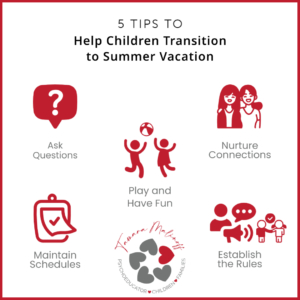
Ask questions to prepare for the transition: Not all children are excited that the school year is over. Some may feel sad because they will miss their friends and teachers. By asking questions, we can validate their emotions. Ask: “What do you think you will miss the most now that the school year is over?” or “Who will you miss the most?”. By allowing children to share their feelings will help them process the transition.

Nurture connections: Try organizing a playdate with good friends within a week or two after school ends. This will help children nurture their connections outside from school. It can also reduce the stress of interrupting their relationships during the break. If your child is missing a teacher or friend that they will not see until the new school year, encourage them to write a letter or draw a picture, then mail or email it to the person.

Maintain schedules: Children thrive on routines and structure. They may not tell us, but the predictability of what comes next helps them feel safe. This does not mean we have to be rigid. We can allow for later nights to celebrate and watch the fireworks; or sit around the firepit at night and roast some marshmallows. Children will do much better if we keep to the same routines, such as sleep and meals. Stick with reasonable bedtimes and support healthy sleep habits. Invest in some blackout blinds/curtains to help them fall asleep when it is still light out at bedtime and the early sunrises.

Establish the rules: We first need to be clear about what our rules and boundaries are before presenting them so that children can be successful. So, if your rule is no screen time before chores and/or physical activities or how far they can bike from home, it needs to be clear and shared in advance. We need to establish the rules ahead of time and hold the boundary with appropriate consequences. Have simple rules that are easy to follow.

Play and have fun: Children learn through play. Lack of play is a health issue and the American Academy of Pediatrics has recommended that pediatricians prescribe play for all children. Through play, children develop a variety of skill sets to optimize their development and help to manage stress. Developmentally appropriate play with parents, caregivers and peers promotes the social-emotional, cognitive, language, and self-regulation skills that build executive function, a prosocial brain and positive behavior. Additionally, play supports the development of nurturing, safe, and stable relationships with caregivers that children need to thrive. So, no matter your plans this summer, try having fun and enjoy the precious moments together.

Wishing all our children, families, and educators a safe and wonderful summer! 

Do you have questions or concerns about your child’s development?

Schedule a Free Call!
Share this entry
  • Share on Facebook
  • Share on X
  • Share on WhatsApp
  • Share on Pinterest
  • Share on LinkedIn
  • Share on Reddit
  • Share by Mail

Archives

  • February 2024
  • June 2022
  • August 2021
  • June 2021
  • April 2021
  • January 2021
  • December 2020

Categories

  • Child Development
  • Early Childhood
  • Middle Childhood
  • Parenting
  • Teens

Follow on Facebook

  • Home
  • About
  • Services
    • Early Childhood
    • Middle Childhood
    • Individual Support
  • Resources
    • Blog
  • Contact

tamaramalinoff.ps.ed

Psychoeducator
❤️Psychoeducation: at the heart of well-being and success
❤️Specializing in child development and behaviors
❤️1:1 psychological support

Hi friends and followers, it’s been a minute! I a Hi friends and followers, it’s been a minute!

I am passionate about mental health matters and put together the following to remind us of the importance of taking care of ourselves from a holistic perspective - physical, emotional, social, spiritual and environmental well-being.

Swipe through and if this resonates with you, please feel free to share❤️
-
-
-
#mentalhealth #mentalhealthawareness #selfcare #selflove #anxiety #love #mentalhealthmatters #depression #motivation #health #selfcareishealthcare #wellness #selfcaresunday #mindfulness #healing #fitness #life #loveyourself #therapy #inspiration #happiness #mindset #psychoeducation #psychotherapy #therapist #wellbeing #recovery #instagood #happy
Children need our attention and often lack the nec Children need our attention and often lack the necessary skills to ask 🗣

Some need more ❤️ than others and may ask for it in the most unloving ways.

What is emotional regulation? It is the ability to control how and when emotions are expressed. 

Big feelings are difficult for young children to navigate, 😡🥺😭so it is our job as parents to model and teach because they are still learning 🧠.

Young children do not have the ability as adults to self-regulate. This is a lifelong process with rapid development through early childhood. How many of us can lose our cool? 🤔

Children need ongoing support with social and emotional learning🤗.

This happens in their every day routines at home, school and any other social interactions. 

It is easy to love someone when they are loveable; let’s choose to see the best in the ones who need it the most❤️

#child 
#childbehavior 
#braindevelopment 
#love 
#parenting 
#parentingtips 
#psychoeducation
When children and teens are acting out or aggressi When children and teens are acting out or aggressive, they are not capable of reasoning and may even be experiencing an adrenalin rush; so, they can’t even hear, let alone have the capacity to reason it out. What they need from us is to help them restore calm and take from our “peaceful” reserve, to achieve the balance they are struggling to attain on their own.

Being calm is not being passive/permissive or shrugging off the issue; it is a mature response that models and teaches an appropriate response to whatever triggered a reaction or emotional response.

Loving unconditionally is to love someone even when they are not so loveable. The most important part is how we manage and control our own emotions when faced with challenging behaviors and to not allow ourselves to be provoked.

When faced with behaviors that are provoking, we need to make a conscious decision in that moment that we refuse to allow ourselves to be provoked. This takes practice, it will get easier as we become aware of our own reactions and response. Modeling calm to someone else’s chaos has an impact, even if we do not see immediate changes, know that it is a long-term investment. ❤️

#child #children #emotions #emotionalintelligence #childbehavior #childdevelopment #tantrums #meltdowns #parenting #parentcoaching #psychoeducation #theearlyyearsfamily
Follow on Instagram
© 2024 Tamara Malinoff, Psychoeducator | All rights reserved.
  • Link to Facebook
  • Link to Instagram
  • Link to LinkedIn
  • Link to Mail
Link to: Whose homework is it? Reduce stress by giving children more control Link to: Whose homework is it? Reduce stress by giving children more control Whose homework is it? Reduce stress by giving children more control Link to: Listen to Your Mother: Teens Response to Verbal Communication Link to: Listen to Your Mother: Teens Response to Verbal Communication Listen to Your Mother: Teens Response to Verbal Communication
Scroll to top Scroll to top Scroll to top