
Get Started: Schedule a session today!
Tamara Malinoff - Psychoeducator
  • Home
  • About
  • Services
    • Early Childhood
    • Middle Childhood
    • Individual Support
  • Resources
    • Blog
  • Contact
  • en EN
    • en EN
    • fr FR
  • Menu Menu

Listen to Your Mother!

The Importance of Verbal Communication to Motivate Teens

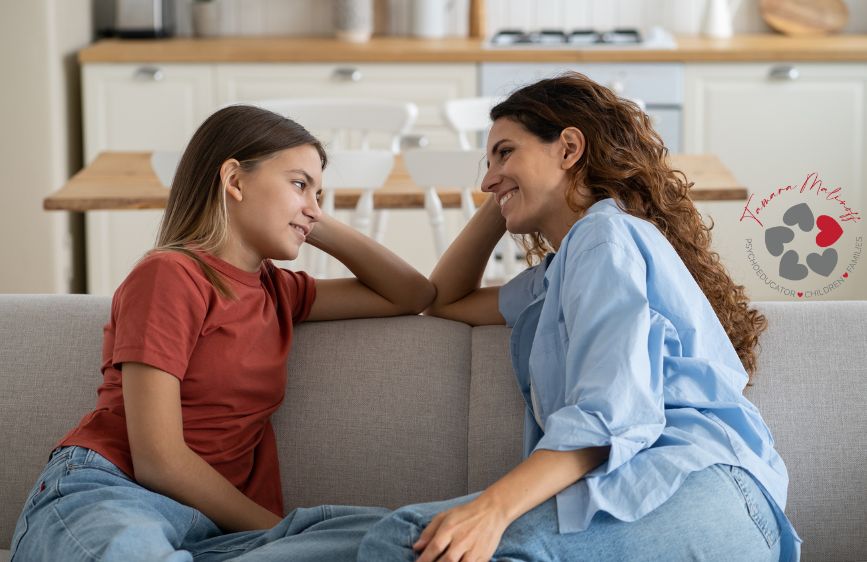
Parents often use verbal communication to motivate their teens to behave a certain way and to cooperate. Developmentally, this is the age where parents, although still present to guide, are to be put on the back burner as peers are the primary source of influence and preference.

Parenting styles

A recent study published in the Journal Developmental Psychology* looked at two common parenting styles when speaking to their teens: authoritarian (controlling) and authoritative (autonomous-supportive). The purpose was to find which one is more effective at motivating teens to follow through and successfully complete tasks they were asked to do.

Researchers at Cardiff University tested the different styles with 1,000 children ages 14 and 15. Mothers of adolescents delivered identical messages in either an autonomy-supportive or with a controlling tone of voice speaking motivational statements such as: “You will do well on this assignment,” and “It’s time now to go to school.”

Listening to mothers making motivating statements in an authoritative tone of voice elicited more positive and less negative emotions. It also increased closeness, and intentional behavioral engagement among adolescents. The opposite occurred when adolescents listened to mothers making motivational statements in authoritarian tone of voice. These findings explain how mothers’ spoken communications has an impact on teens, as well as on the quality of parent-child relationships, adolescents’ well-being, and engagement.

Teens in the study reported feeling a sense of closeness and positive emotions when tasks were communicated in the supportive tone.

What can parents learn?

The findings may not be surprising to many parents, but it is a good reminder.

“If parents want conversations with their teens to have the most benefit, it’s important to remember to use supportive tones of voice. It’s easy for parents to forget, especially if they are feeling stressed, tired, or pressured themselves.”

Dr. Netta Weinstein

Positive tips for parenting teens:

  • Engage with your teen: find a common ground, a family game night, cook together and as often as possible, eat together.
  • Try hard not to be provoked: No one knows us better than our own children; let go of the little things and choose the bigger battles.
  • Model behaviors we want more of: Treat them with kindness and respect and we will see more of these behaviors in return.
  • Apologize if and whenever we lose it: This teaches we all make mistakes and how to apologize.
  • Effectively communicate: Try face-to-face over virtual communication and pay attention to voice tone as much as body language.
  • Be authentic and be their biggest fan: Believe in them and they will become who they are supposed to be.

Our children look to us for guidance and to be their safe space. Not always easy to do, so remember that there are no perfect parents, we are all perfectly imperfect and trying our best. Take time to enjoy something just for you each day. With the right perspective, we can find joy  in the little things.

*Reference: Journal Developmental Psychology “Listen to Your Mother: Motivating Tones of Voice Predict Adolescents’ Reactions to Mothers.”
Click here to download a Practical Guide to Parental Wellness
Share this entry
  • Share on Facebook
  • Share on X
  • Share on WhatsApp
  • Share on Pinterest
  • Share on LinkedIn
  • Share by Mail
  • Link to Instagram

Archives

  • February 2024
  • June 2022
  • August 2021
  • June 2021
  • April 2021
  • January 2021
  • December 2020

Categories

  • Child Development
  • Early Childhood
  • Middle Childhood
  • Parenting
  • Teens

Follow on Facebook

  • Home
  • About
  • Services
    • Early Childhood
    • Middle Childhood
    • Individual Support
  • Resources
    • Blog
  • Contact

tamaramalinoff.ps.ed

Psychoeducator
❤️Psychoeducation: at the heart of well-being and success
❤️Specializing in child development and behaviors
❤️1:1 psychological support

Hi friends and followers, it’s been a minute! I a Hi friends and followers, it’s been a minute!

I am passionate about mental health matters and put together the following to remind us of the importance of taking care of ourselves from a holistic perspective - physical, emotional, social, spiritual and environmental well-being.

Swipe through and if this resonates with you, please feel free to share❤️
-
-
-
#mentalhealth #mentalhealthawareness #selfcare #selflove #anxiety #love #mentalhealthmatters #depression #motivation #health #selfcareishealthcare #wellness #selfcaresunday #mindfulness #healing #fitness #life #loveyourself #therapy #inspiration #happiness #mindset #psychoeducation #psychotherapy #therapist #wellbeing #recovery #instagood #happy
Children need our attention and often lack the nec Children need our attention and often lack the necessary skills to ask 🗣

Some need more ❤️ than others and may ask for it in the most unloving ways.

What is emotional regulation? It is the ability to control how and when emotions are expressed. 

Big feelings are difficult for young children to navigate, 😡🥺😭so it is our job as parents to model and teach because they are still learning 🧠.

Young children do not have the ability as adults to self-regulate. This is a lifelong process with rapid development through early childhood. How many of us can lose our cool? 🤔

Children need ongoing support with social and emotional learning🤗.

This happens in their every day routines at home, school and any other social interactions. 

It is easy to love someone when they are loveable; let’s choose to see the best in the ones who need it the most❤️

#child 
#childbehavior 
#braindevelopment 
#love 
#parenting 
#parentingtips 
#psychoeducation
When children and teens are acting out or aggressi When children and teens are acting out or aggressive, they are not capable of reasoning and may even be experiencing an adrenalin rush; so, they can’t even hear, let alone have the capacity to reason it out. What they need from us is to help them restore calm and take from our “peaceful” reserve, to achieve the balance they are struggling to attain on their own.

Being calm is not being passive/permissive or shrugging off the issue; it is a mature response that models and teaches an appropriate response to whatever triggered a reaction or emotional response.

Loving unconditionally is to love someone even when they are not so loveable. The most important part is how we manage and control our own emotions when faced with challenging behaviors and to not allow ourselves to be provoked.

When faced with behaviors that are provoking, we need to make a conscious decision in that moment that we refuse to allow ourselves to be provoked. This takes practice, it will get easier as we become aware of our own reactions and response. Modeling calm to someone else’s chaos has an impact, even if we do not see immediate changes, know that it is a long-term investment. ❤️

#child #children #emotions #emotionalintelligence #childbehavior #childdevelopment #tantrums #meltdowns #parenting #parentcoaching #psychoeducation #theearlyyearsfamily
Follow on Instagram
© 2024 Tamara Malinoff, Psychoeducator | All rights reserved.
  • Link to Facebook
  • Link to Instagram
  • Link to LinkedIn
  • Link to Mail
Link to: Helping Children Transition to Summer Vacation Link to: Helping Children Transition to Summer Vacation Helping Children Transition to Summer Vacation
Scroll to top Scroll to top Scroll to top