
As the school year is upon us and our children are adjusting to their routines, how are we tolerating stress? Children, regardless of age, need supportive adults in their lives to nurture and guide them through stressful circumstances and events; they also need to have a sense of control over their own lives.
Stress can be helpful or harmful.
The times when our brains are most vulnerable to stress are prenatal stress, early childhood, and adolescence, this is because brains only reach full maturity by age 25. Anxiety is most likely to develop in teens because they are more vulnerable to stress with fewer tools to cope.
Let’s look at 3 different types of stress:
Positive stress is short in duration. We may feel a slight increase in our heart rate and mild changes in the body’s stress hormones. This is normal everyday stress which serves to motivate children and adults to grow, take risks, and persevere.
Tolerable stress refers to stress responses that have the potential to negatively impact brain development. It generally occurs for short periods of time which allows for the brain to recover and reduce harmful effects. Some events may include an episode of being bullied, a serious illness, separation, divorce, or a death in the family. The presence of supportive adults is crucial to help children feel safe. Additionally, this type of stress can help build resilience.
Toxic stress refers to the frequent and prolonged activation of the body’s stress system. There is a recurrence of stressful events with little reprieve. Furthermore, there is the absence of support from caring adults who would protect and minimize a child’s exposure to harmful events that a child is not developmentally prepared to cope with. Extreme exposure can be witnessing an assault or abuse which occurs regularly. This is the most dangerous one for a child’s developing brain. Also, it damages their ability to thrive.
“A poorly controlled response to stress can be damaging to health and well-being if activated too often or for too long.”
Center on the Developing Child
Toxic stress is not healthy for us, at any age. However, certain times are worse than others and can have a great impact on healthy brain development when there is excessive or prolonged activation of the stress response systems. Moreover, if the body and brain are not given the proper time to recover, chronic stress can lead to anxiety and depression. It can also lead to problematic behaviors such as binge or restricted eating, procrastination, sleep issues, and a lack of motivation to care for oneself.
Parenting styles play a role, how?
Let’s take a moment to reflect on how this may impact the way we parent our children.
The 3 main types of parenting styles are: Authoritarian, Authoritative and Permissive. (We may fluctuate between all 3).
With over 60 years of research in support of this parenting style, an authoritative parent coaches, guides, and supports their children while maintaining healthy boundaries, which is said to be the most effective parenting style, compared to authoritarian, permissive, ambivalent or uninvolved parenting styles.
This is the one we strive to be as an authoritative parents set high expectations while nurturing, are responsive, and involved. Children raised by authoritative parents are more likely to have greater autonomy, be socially accepted, academically successful, and are generally well-behaved.
“Tell me and I forget, teach me and I may remember, involve me and I learn.”
Benjamin Franklin
Parents can play a role in undue stress on their children when constantly battling over things like homework, expectations, and pressure to do well at school, social relationships with friends, and many extracurricular commitments. Chronic fighting is not healthy for families.
Give children more control and responsibility
Brains develop according to how it is used. When we give children opportunities to make decisions while they are young, helps the brain to develop, so that they can cope with stress as they become more resilient. Children need responsibilities now, not when we think they are old enough to handle it or when they are more mature.
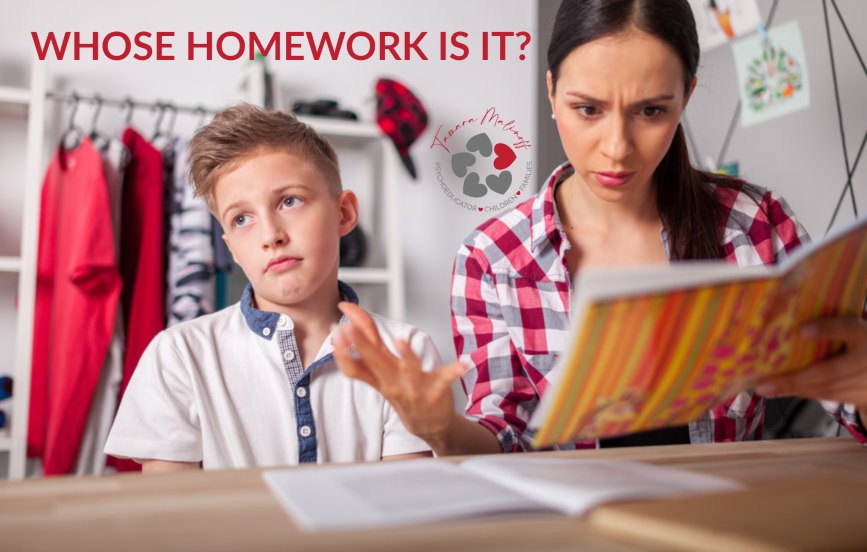
Whose homework is it?
Many parents feel responsible to be on top of their children’s homework. The intentions are good as we want to see our children succeed. However, we may find ourselves doing the work or providing the answers, so there is not much learning happening, it becomes our homework.
I would like to propose a new approach to homework by handing over more control to your children so that homework becomes the child’s responsibility.
Now, this does not mean leaving them to their own devices and saying, “you’re on your own kid!”, the opposite is true. We remain present, supportive, and trust that they have what it takes. Trust begets more trust.
Practical tools to get the year off to a fresh start:
Be their coaches: Believe in your child’s ability to manage their own homework so that they can have the confidence to believe in themselves. We coach but must not force. The same principle applies to sports or other activities we want to enroll them in.
Connection over correction: Resist the temptation to say: “I told you so!” when they learn the consequences of not having done their work. Validate! Say: “I know how hard this is. If you need me, I am here for you”. Let them know that when mistakes happen, they are growth opportunities. Talk about your failures and struggles to do homework or when you would rather be out playing with friends. It is hard, we can empathize.
Offer support guidance: Tell your child: “I love you too much to fight over your homework”. Instead of asking “what homework do you have tonight?”, ask: “Would you like my help tonight with any of the subjects you have for homework?”.
Build healthy habits: Children thrive on routines and structure. Teach them to eat healthy and to get enough sleep. Allow them to make choices to develop habits and routines that feel right for them. Lead by example in how we take care of ourselves, they are learning through observation.
Academic support: Children tend to do better when it is someone other than a parent to work with. However, there are different approaches to ensure their success. If they are struggling to master a subject, see about getting additional support from tutors or if their school has an after-school homework program with peers or older students. If they are strong students but struggle with time management, prioritizing assignments, or may have difficulties with executive functioning, then an academic coach to teach organizational and study skills.
To conclude, keep in mind that after a long day at school, coming home to many more hours of tutoring can have a negative impact. It is important to balance work and play.
Wishing all our students, parents and teachers a safe and wonderful school year. 
References:
National Scientific Council on the Developing Child (2005/2014). Excessive Stress Disrupts the Architecture of the Developing Brain: Working Paper No. 3. Updated Edition. Retrieved from www.developingchild.harvard.edu.
Stixrud, W. R., & Johnson, N. (2019). The self-driven child: The science and sense of giving your kids more control over their lives. NY, NY: Penguin Books.